Skull Tattoo: 25 Designs and Meanings
A skull tattoo is one of the oldest and boldest designs in tattooing — a symbol of mortality, courage and living fully that has survived every trend cycle. This guide covers 25 skull tattoo designs, from sugar skulls and realistic skulls to skull-and-rose pairings, plus the honest truth about placement, pain, cost and aftercare.
Skulls suit almost every style, from fine line to blackwork to full colour, and they work at nearly every size — which is why they appear on forearms, chests, backs and fingers alike. Below, each design has its own meaning, detail notes, size guidance and best placement, so you can pick the one that fits the story you want to wear.
What Does a Skull Tattoo Mean?
At its root, a skull tattoo is memento mori — remember you will die. That sounds dark, but most wearers mean the opposite: because life is short, live it fully and without fear. The skull has also meant protection in many traditions, a ward against death itself, and courage — the willingness to look at the end without flinching. Sugar skulls add celebration to the symbol, honouring the dead with colour and flowers instead of mourning them. The pairing changes the meaning more than the skull alone does: a skull with a rose is beauty and death together, a skull with a clock is time passing, and a skull with wings is the soul set free. Whatever the pairing, the meaning is personal in the end, and a good artist will ask what yours is before the needle starts.
Skull Tattoo Designs: 25 Ideas
Classic Skull Styles
1. Sugar skull on the forearm.
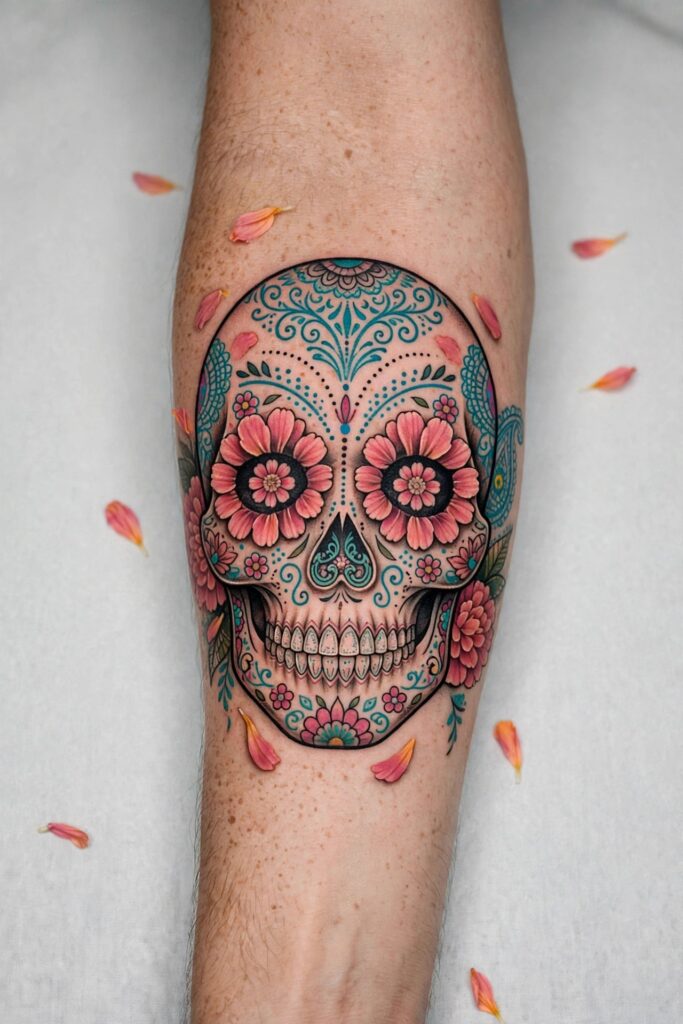
Meaning: A celebration of life and remembrance — the decorated sugar skull honours the dead during Día de los Muertos instead of fearing death.
Design details: Bright marigold, pink and turquoise patterns over a white skull base, with flower petals around the eyes and fine dotwork.
Size: 3–6 inches tall.
Best placement: Forearm, because the flat surface shows the colour work and the design stays visible.
Recommended size: 4–5 inches tall, so the small decorative details stay readable.
Best for wearers who want a skull with joy in it, not darkness.
2. Realistic human skull on the upper arm.
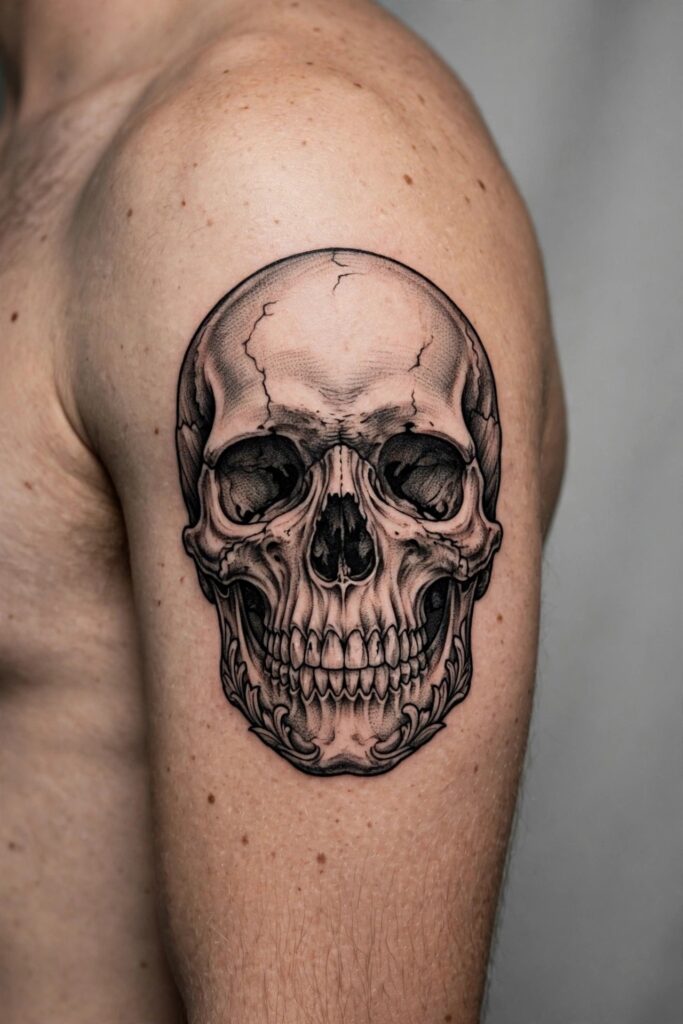
Meaning: Mortality faced head-on — a realistic skull is the most direct memento mori there is.
Design details: Black and grey realism with careful shading on the cheekbones, teeth and eye sockets, no colour.
Size: 3–6 inches tall.
Best placement: Upper arm, where the rounded muscle suits the skull’s shape and there is room for shading.
Recommended size: 4–5 inches tall; smaller and the teeth blur into shadow.
Best for wearers who want the starkest version of the symbol.
3. Traditional bold skull on the shoulder.
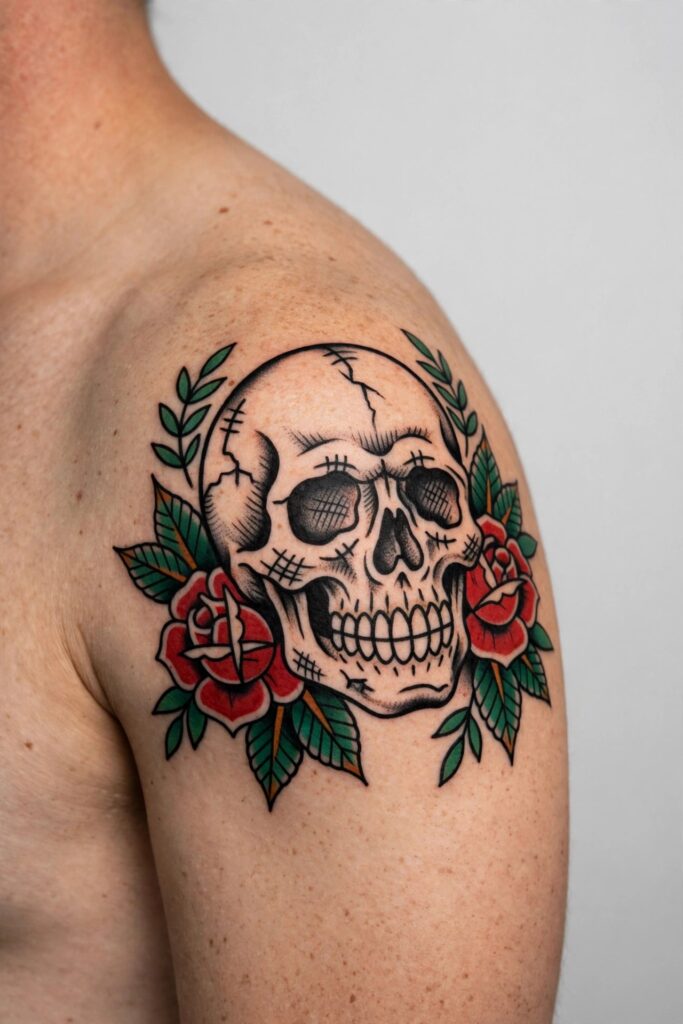
Meaning: Old-school toughness — the traditional skull has marked sailors, soldiers and rebels for a century.
Design details: Bold black outline, flat colour fills, minimal shading, in the classic American traditional style.
Size: 3–5 inches across.
Best placement: Shoulder, a classic spot that fits the round composition and ages well.
Recommended size: 3–4 inches across; bold lines hold up at this size for decades.
Best for wearers who love traditional tattooing.
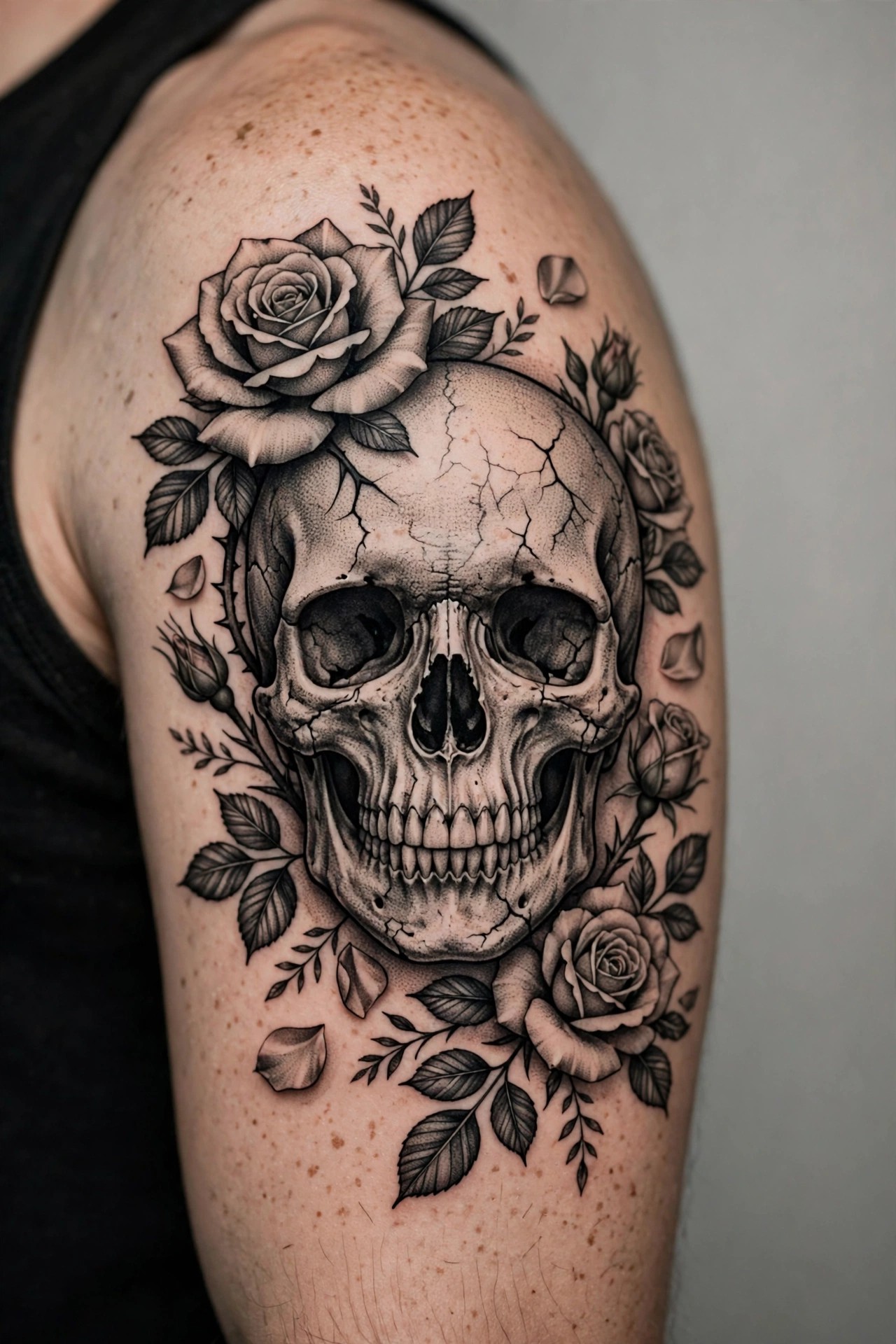
4. Gothic skull with roses on the shoulder.
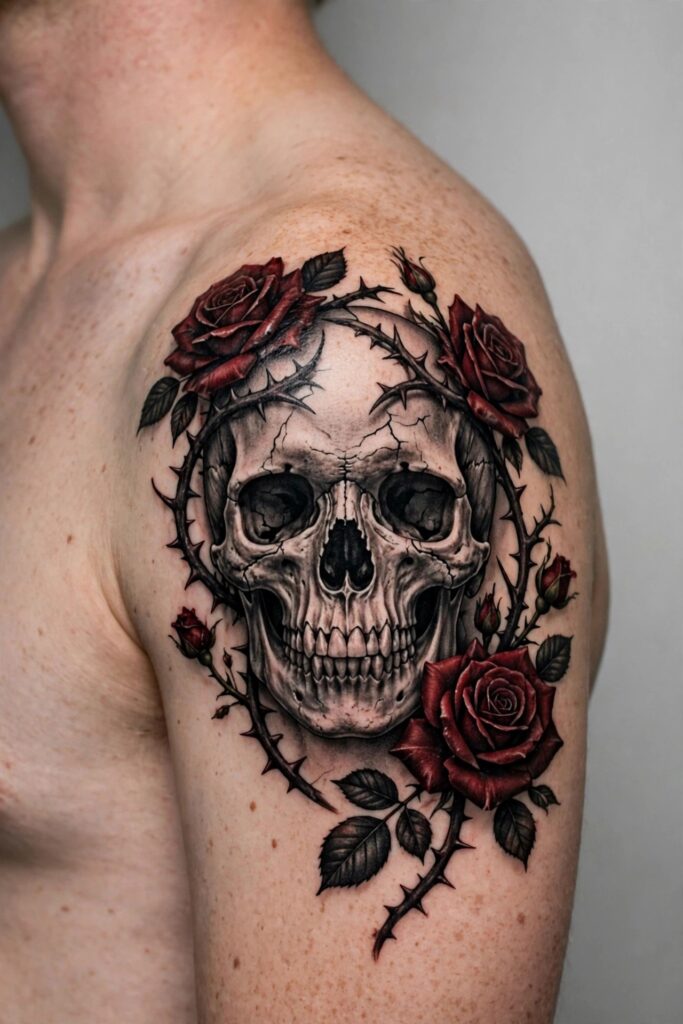
Meaning: Beauty and death in one image — the roses soften the skull without weakening it.
Design details: Black and grey skull with dark red or black roses, thorns and leaves wrapping the jaw.
Size: 4–7 inches across.
Best placement: Shoulder, where the roses can spread around the skull naturally.
Recommended size: 5–6 inches across, so the rose petals keep their shape.
Best for wearers who want darkness with romance in it.
5. Skull and snake on the forearm.
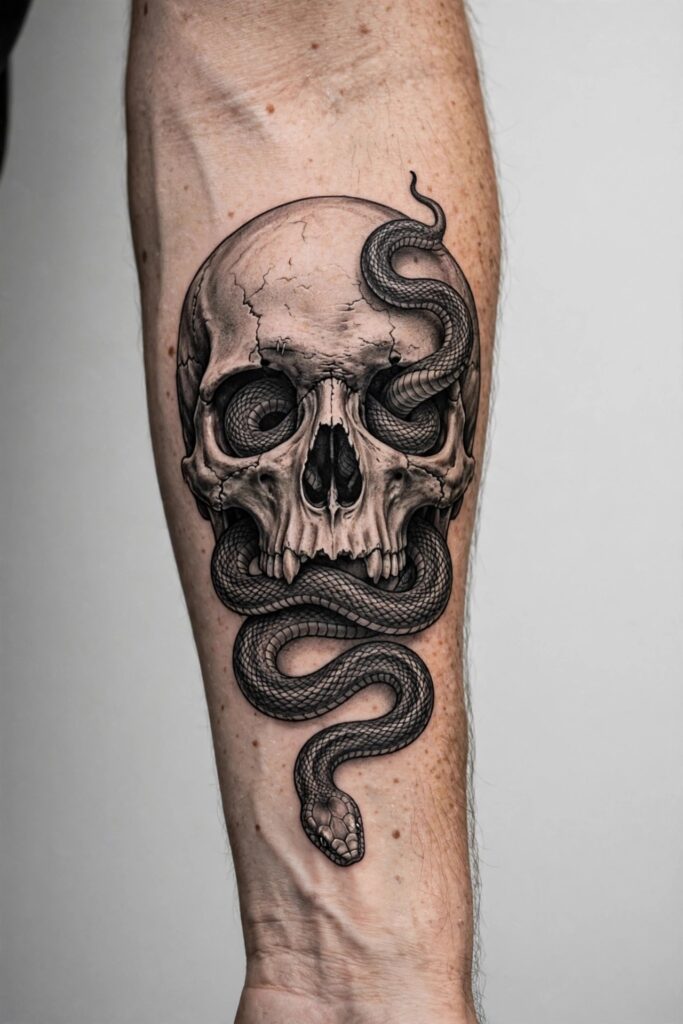
Meaning: Temptation and mortality together — the snake’s rebirth against the skull’s finality.
Design details: Snake coiling through the skull’s eye sockets, black and grey with fine scale detail.
Size: 4–7 inches long.
Best placement: Forearm, because the length lets the snake coil naturally along the limb.
Recommended size: 5–6 inches long, so the coil has room to breathe.
Best for wearers who want a piece with real movement.
6. Skull with a crown on the forearm.
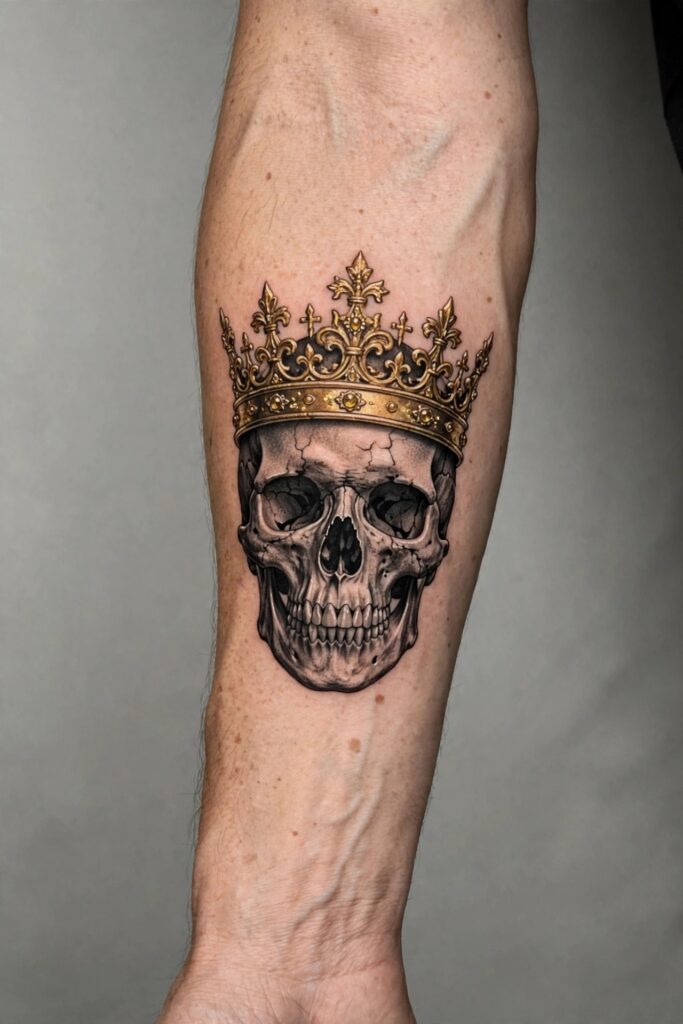
Meaning: Power beyond death — the crown says the wearer answers to no one, in life or after it.
Design details: Detailed crown sitting on the skull, gold or black and grey, with small jewels or points.
Size: 3–5 inches tall.
Best placement: Forearm, where the vertical shape fits the crown-over-skull stack.
Recommended size: 4 inches tall, keeping the crown’s points sharp.
Best for wearers who want their skull to rule.
7. Skull with candles on the chest.
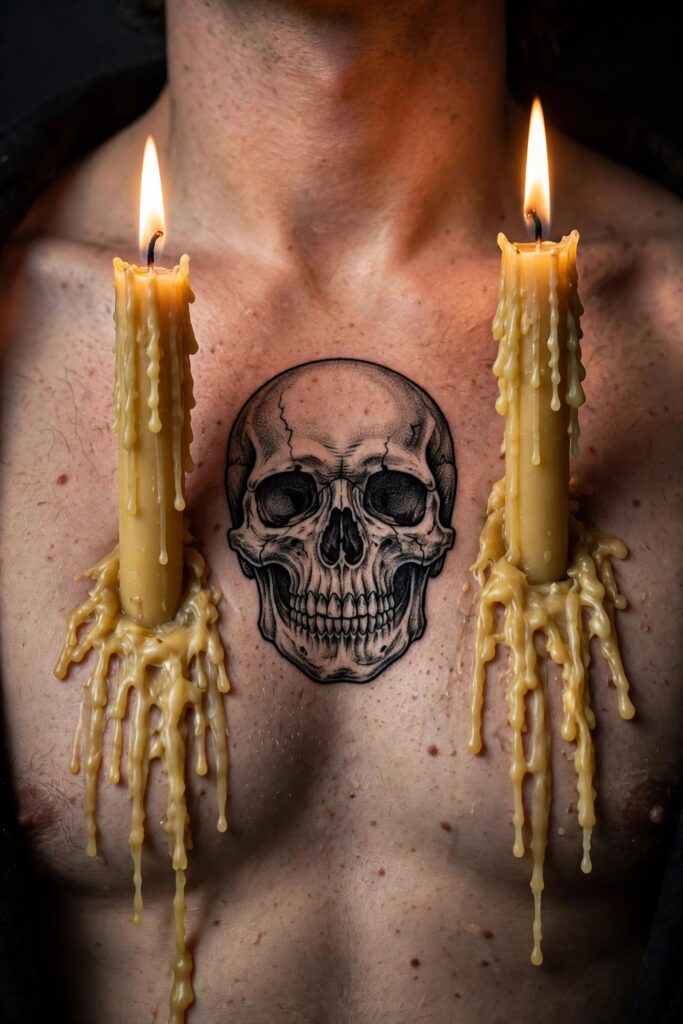
Meaning: Light kept burning for the dead — the candles are a vigil, a flame that refuses to go out.
Design details: Tall candles burning beside the skull, wax dripping down, warm glow against black and grey shading.
Size: 4–7 inches tall.
Best placement: Chest, centred, where the candles can stand tall above the skull.
Recommended size: 5–6 inches tall, so the candle flames stay distinct.
Best for wearers keeping a light burning for someone gone.
8. Skull with a moth on the shoulder blade.
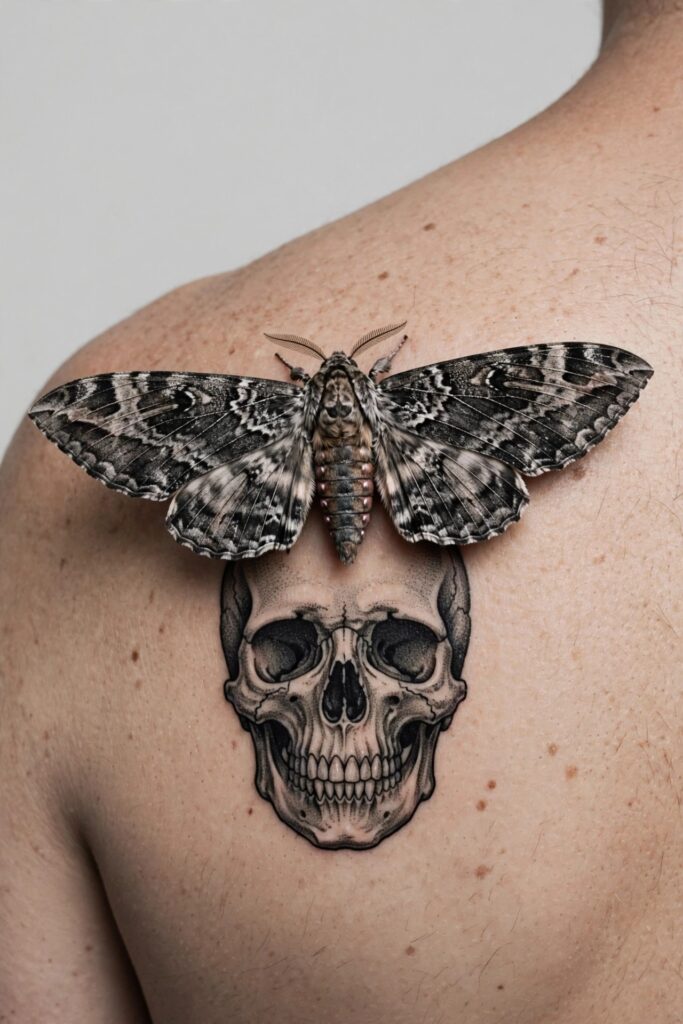
Meaning: Transformation and death together — the moth is drawn to light the way the skull reminds us of the dark.
Design details: Death’s-head moth with wings spread across the skull, detailed wing patterns in black and grey.
Size: 4–7 inches wingspan.
Best placement: Shoulder blade, where the flat surface fits the wingspan.
Recommended size: 5–6 inches wingspan, so the wing markings stay crisp.
Best for wearers drawn to dark, detailed imagery.
9. Skull and dagger on the forearm.
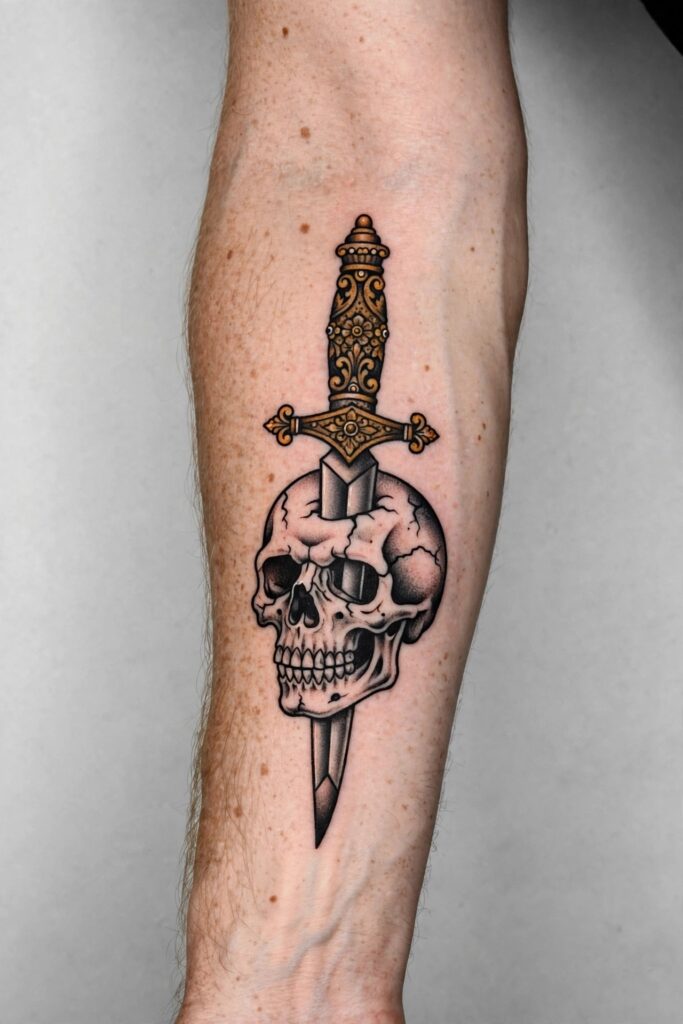
Meaning: Betrayal survived or a threat answered — the dagger through the skull is a story of coming out the other side.
Design details: Dagger piercing the skull from top to jaw, bold lines with a decorated handle.
Size: 4–7 inches long.
Best placement: Forearm, where the vertical dagger shape runs along the limb.
Recommended size: 5–6 inches long, keeping the blade straight and readable.
Best for wearers with a story of surviving something sharp.
10. Skull with a butterfly on the shoulder.
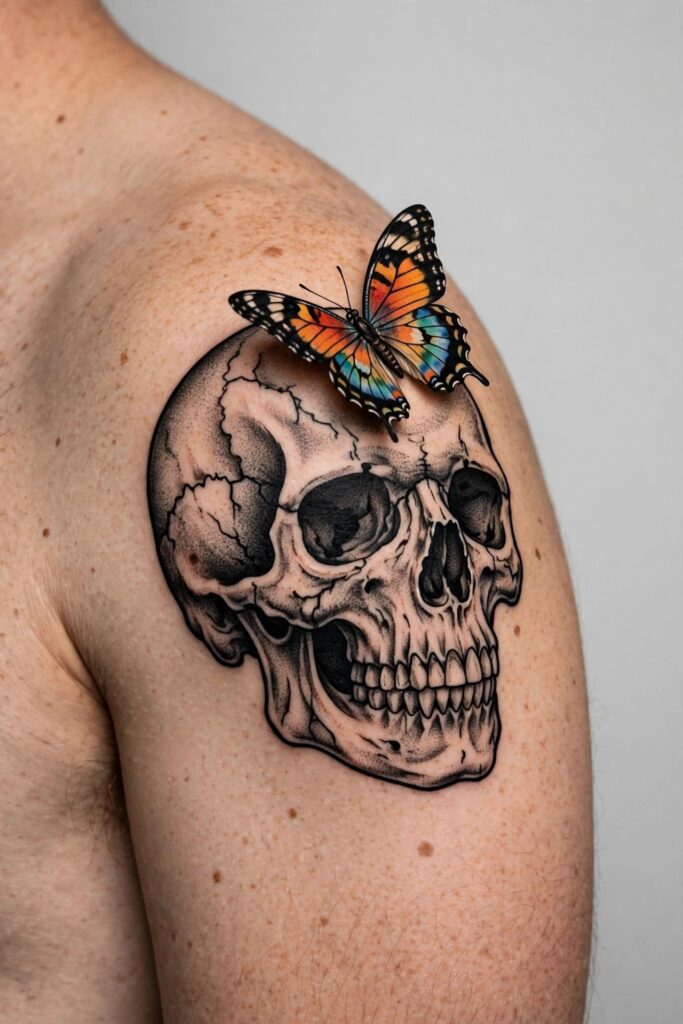
Meaning: Rebirth after loss — the butterfly’s transformation softens the skull’s finality into hope.
Design details: Colourful butterfly resting on the skull, wings open, black and grey skull with colour in the wings.
Size: 3–6 inches across.
Best placement: Shoulder, where the butterfly can sit naturally above the skull.
Recommended size: 4–5 inches across, so the butterfly’s wings keep their detail.
Best for wearers marking a loss that became a new start.
Skull Tattoos with Meaningful Pairings
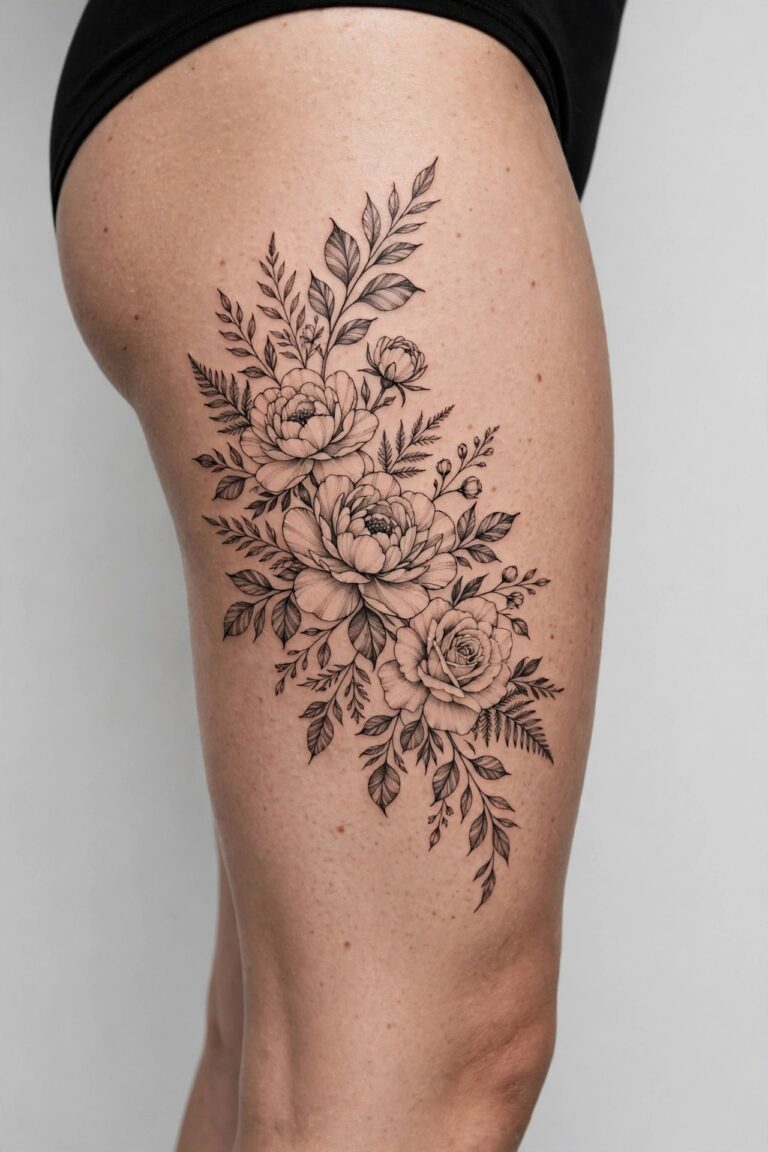
11. Skull with a peony on the thigh.
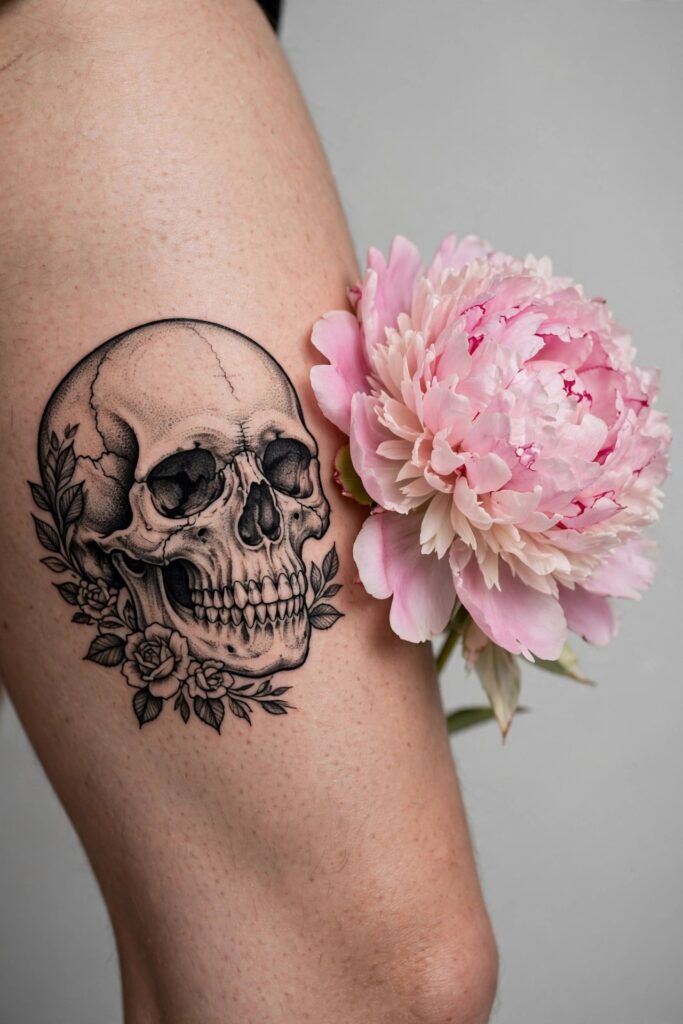
Meaning: Beauty growing from death — the peony’s lush bloom against the skull is life insisting on itself.
Design details: Large soft peony in pink or red beside a black and grey skull, petals layered and full.
Size: 5–8 inches tall.
Best placement: Thigh, where there is room for the flower to open fully.
Recommended size: 6–7 inches tall, so the petals stay layered and soft.
Best for wearers who want a large piece with real softness in it.
12. Skull with a clock on the forearm.
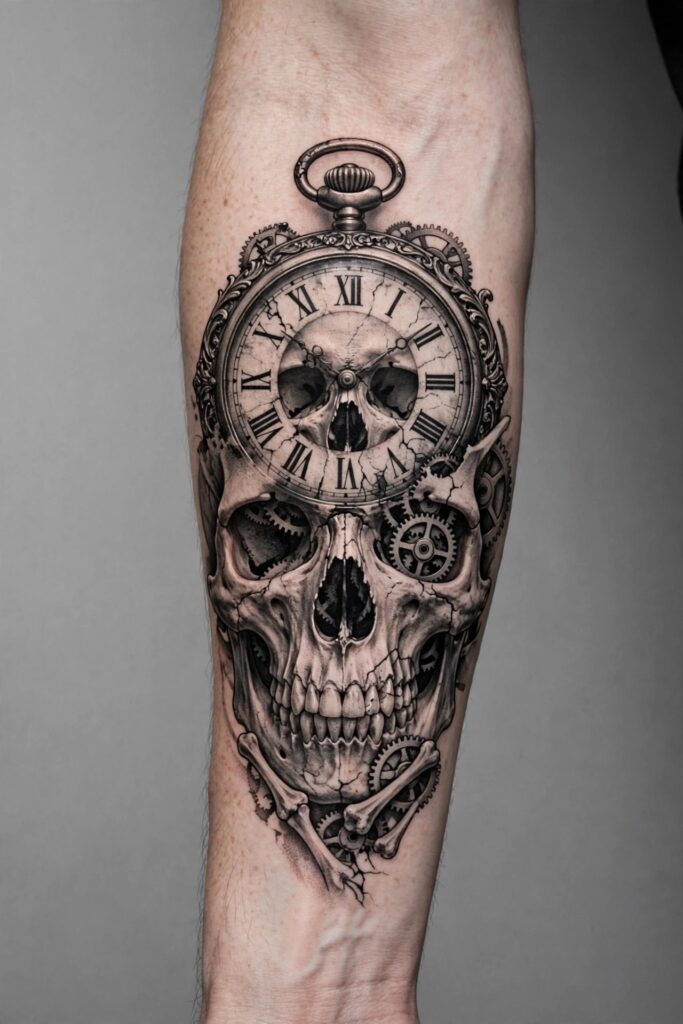
Meaning: Time passing — the clock face on the skull is the bluntest reminder that every hour counts.
Design details: Vintage pocket-watch face merged with the skull, Roman numerals, black and grey.
Size: 3–6 inches tall.
Best placement: Forearm, where the clock face stays visible to the wearer.
Recommended size: 4–5 inches tall, so the numerals stay legible.
Best for wearers who carry time with them.
13. Skull and raven on the back.
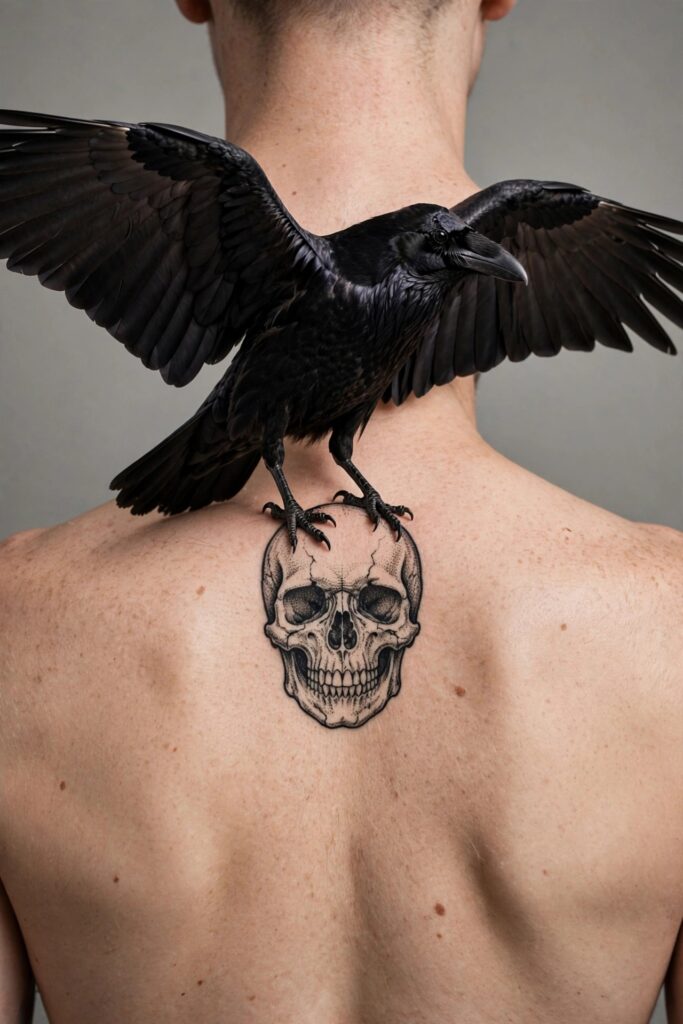
Meaning: Death’s messenger — the raven has watched over battlefields and graveyards in story for centuries.
Design details: Raven perched on or flying from the skull, feathers in fine blackwork, wings spread.
Size: 6–10 inches across.
Best placement: Upper back, where the wings can spread across the shoulder blades.
Recommended size: 7–8 inches across, so the feathers keep their detail.
Best for wearers who want a large, dark centrepiece.
14. Skull with wings on the upper back.
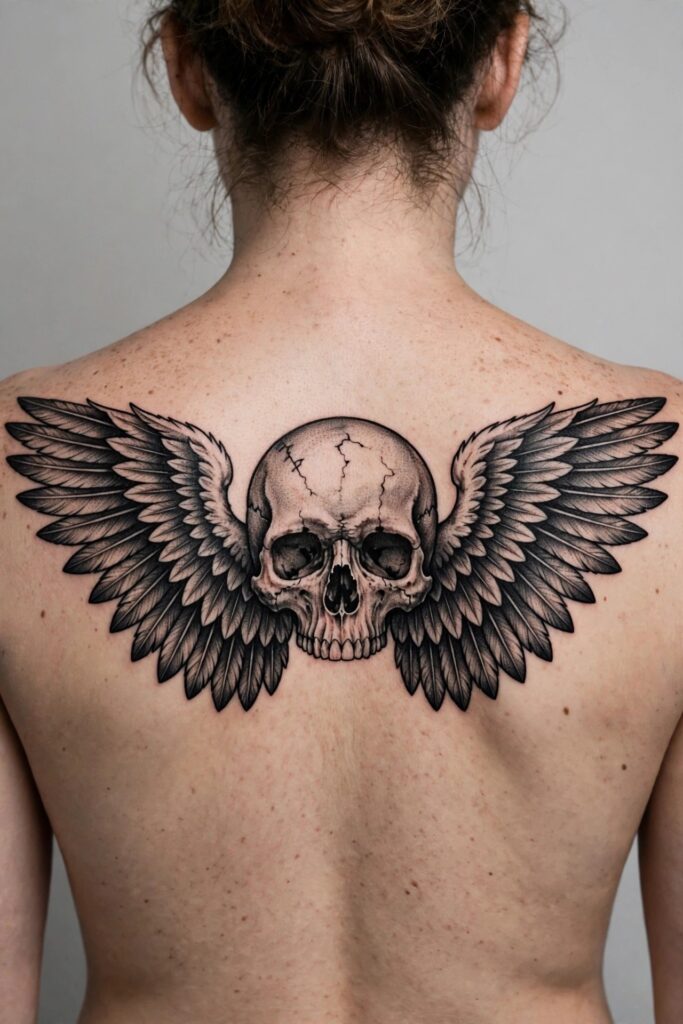
Meaning: Freedom after death — the winged skull is the soul leaving the body, not trapped by it.
Design details: Feathered or bat-like wings spread from the skull, symmetrical, black and grey.
Size: 6–10 inches wingspan.
Best placement: Upper back, centred between the shoulder blades, where wings belong.
Recommended size: 7–8 inches wingspan, keeping the feathers symmetrical.
Best for wearers who want their skull to fly.
15. Skull and hourglass on the forearm.
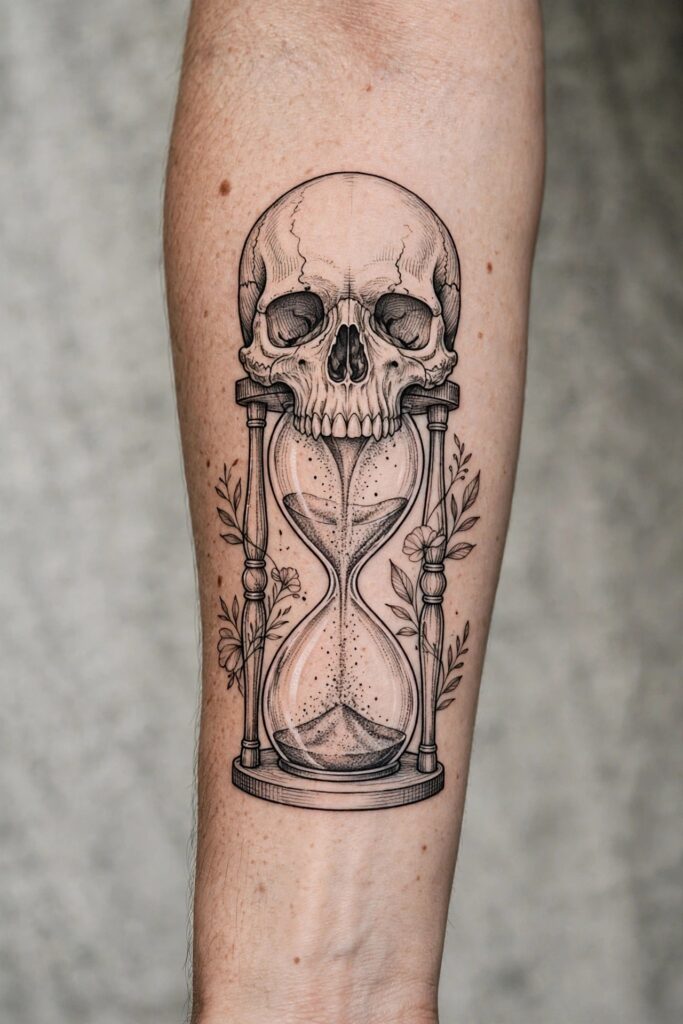
Meaning: Time running out — the hourglass makes the skull’s warning literal, sand and all.
Design details: Hourglass with falling sand beside or inside the skull, fine lines, black and grey.
Size: 3–6 inches tall.
Best placement: Forearm, where the vertical hourglass shape runs along the limb.
Recommended size: 4–5 inches tall, so the sand detail stays visible.
Best for wearers who feel the clock ticking.
16. Skull with a laurel wreath on the chest.
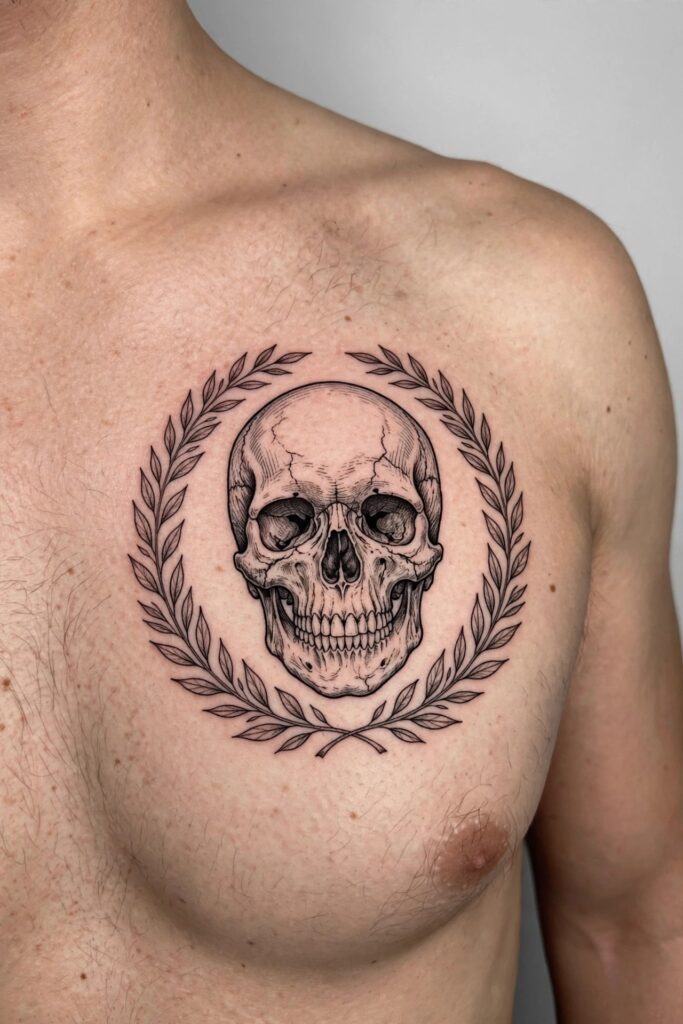
Meaning: Honour in death — the laurel is the victor’s crown, so this skull is remembered, not feared.
Design details: Laurel leaves circling the skull, fine linework, black and grey with optional gold.
Size: 4–7 inches across.
Best placement: Chest, centred, where the wreath’s circle sits naturally.
Recommended size: 5–6 inches across, so the leaves stay distinct.
Best for wearers honouring someone who earned remembering.
17. Skull with the moon and stars on the shoulder.
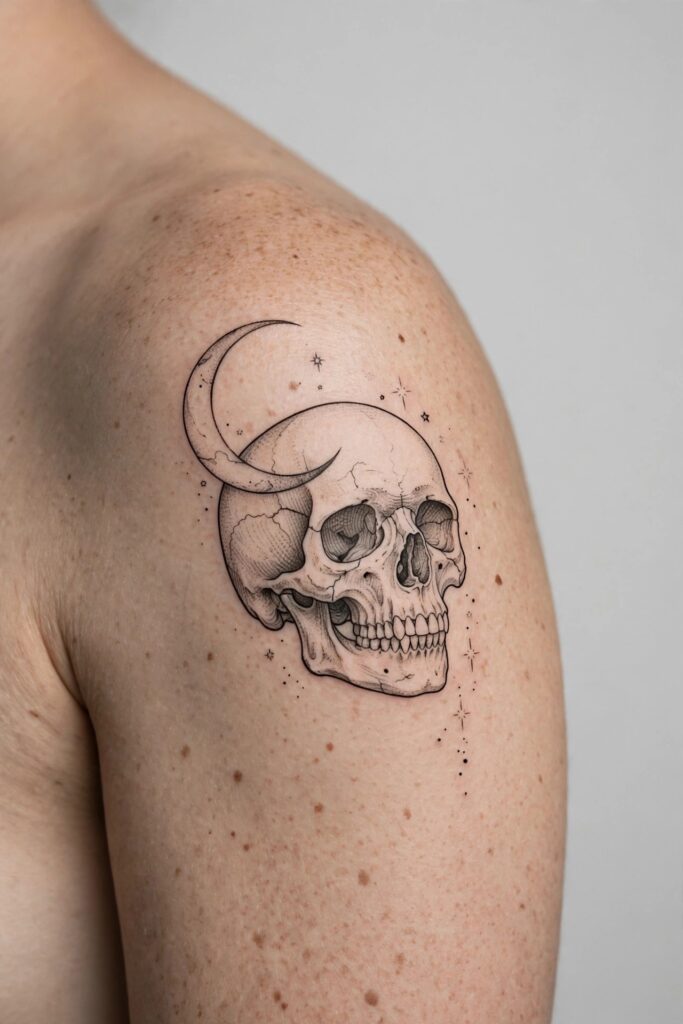
Meaning: Death and the night sky — the skull under the moon is a quiet, almost peaceful piece.
Design details: Crescent moon and small stars around the skull, fine lines, black and grey with soft shading.
Size: 3–6 inches across.
Best placement: Shoulder, where the moon can sit above the skull naturally.
Recommended size: 4–5 inches across, keeping the stars from crowding.
Best for wearers who want a skull that feels calm, not loud.
18. Skull and anchor on the forearm.
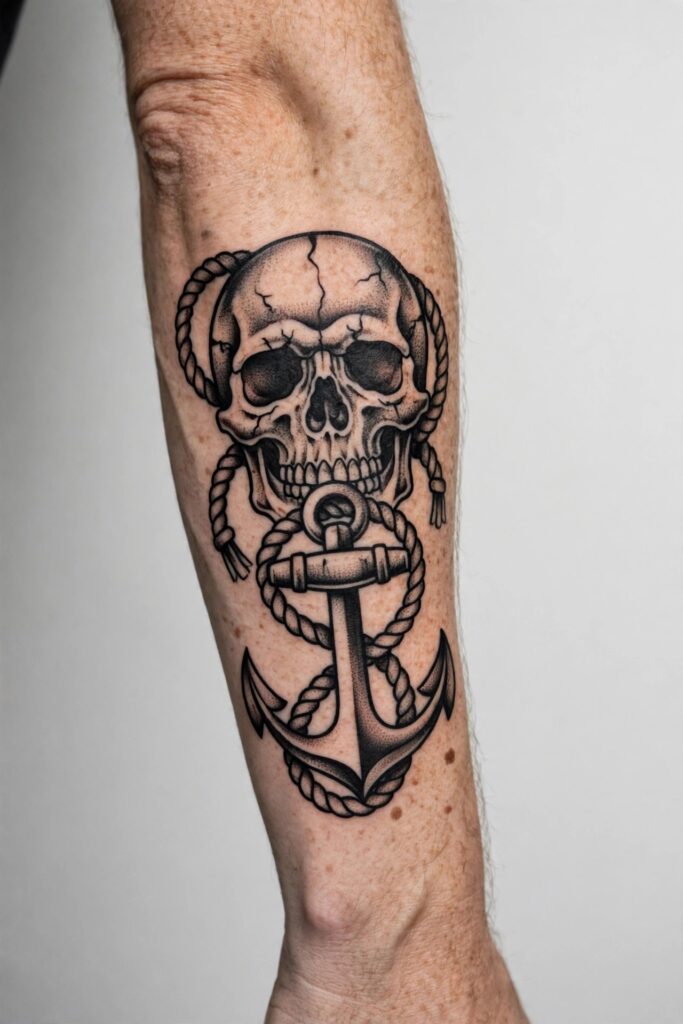
Meaning: Holding fast through the storm — the anchor says the wearer stays steady even when everything else sinks.
Design details: Bold anchor crossed with the skull, traditional style, black and grey or navy.
Size: 4–7 inches long.
Best placement: Forearm, where the anchor’s vertical shape fits the limb.
Recommended size: 5–6 inches long, so the anchor’s flukes stay bold.
Best for wearers who have weathered something and stayed put.
19. Skull and compass on the forearm.
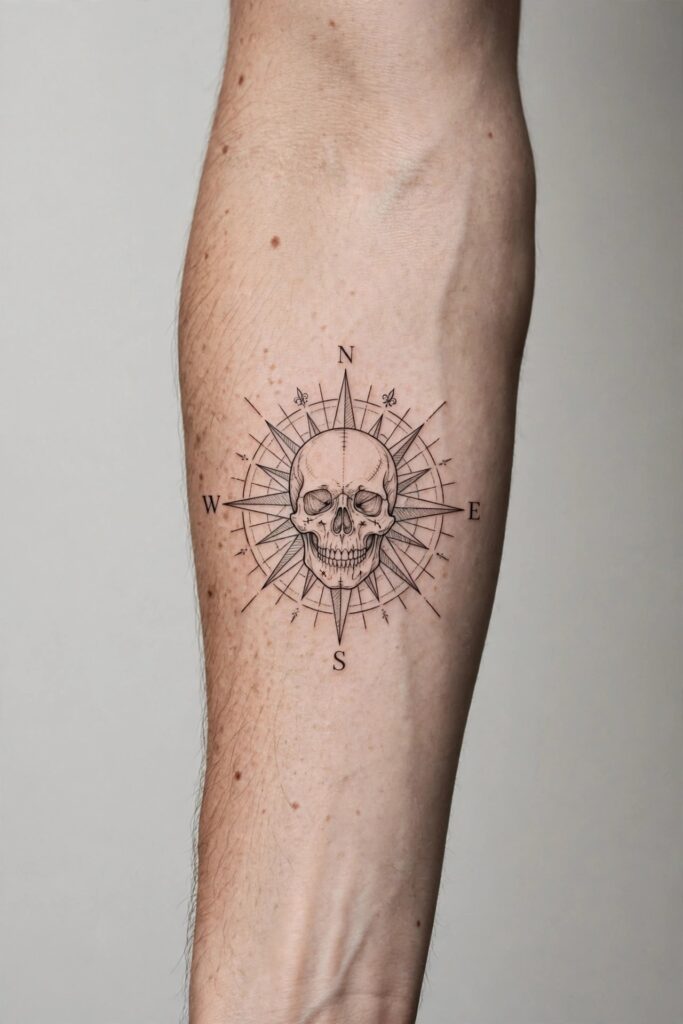
Meaning: Direction through darkness — the compass says the wearer finds their way even without light.
Design details: Compass rose behind or below the skull, fine lines with N/E/S/W points.
Size: 3–6 inches across.
Best placement: Forearm, where the round compass fits the flat surface.
Recommended size: 4–5 inches across, so the compass points stay sharp.
Best for wearers navigating by their own star.
20. Skull and sword on the thigh.
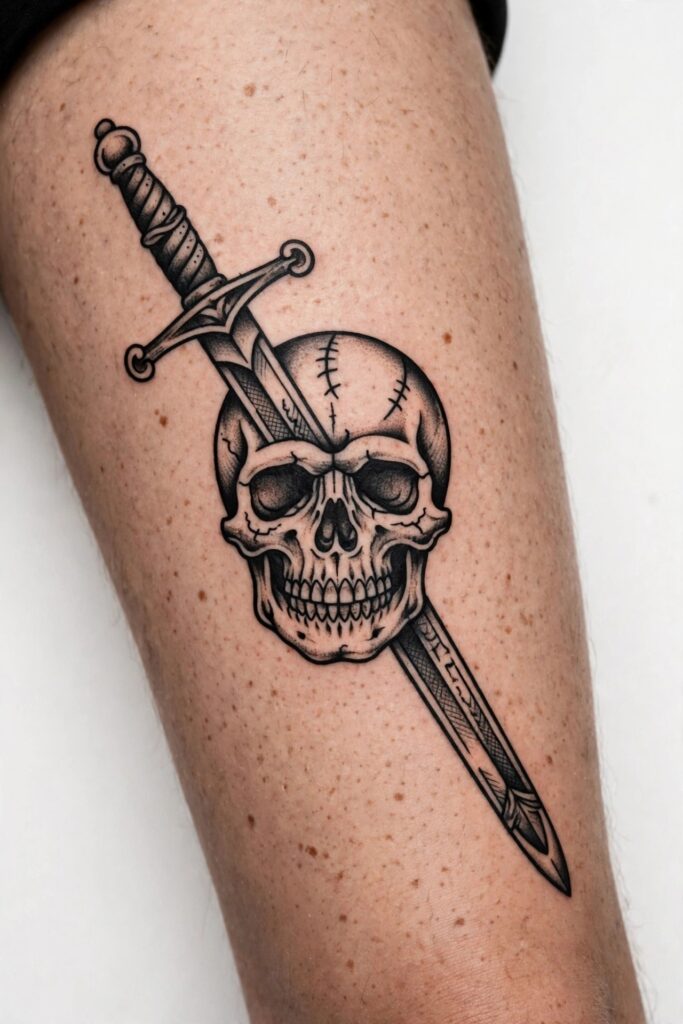
Meaning: A fight finished — the sword through or beside the skull is victory over an enemy, or over fear itself.
Design details: Long sword crossed with the skull, bold traditional or realistic, black and grey.
Size: 6–9 inches long.
Best placement: Thigh, where the sword’s length has room to run.
Recommended size: 7–8 inches long, keeping the blade straight and strong.
Best for wearers who won their fight.
Small and Subtle Skull Tattoos
21. Small skull on the wrist.
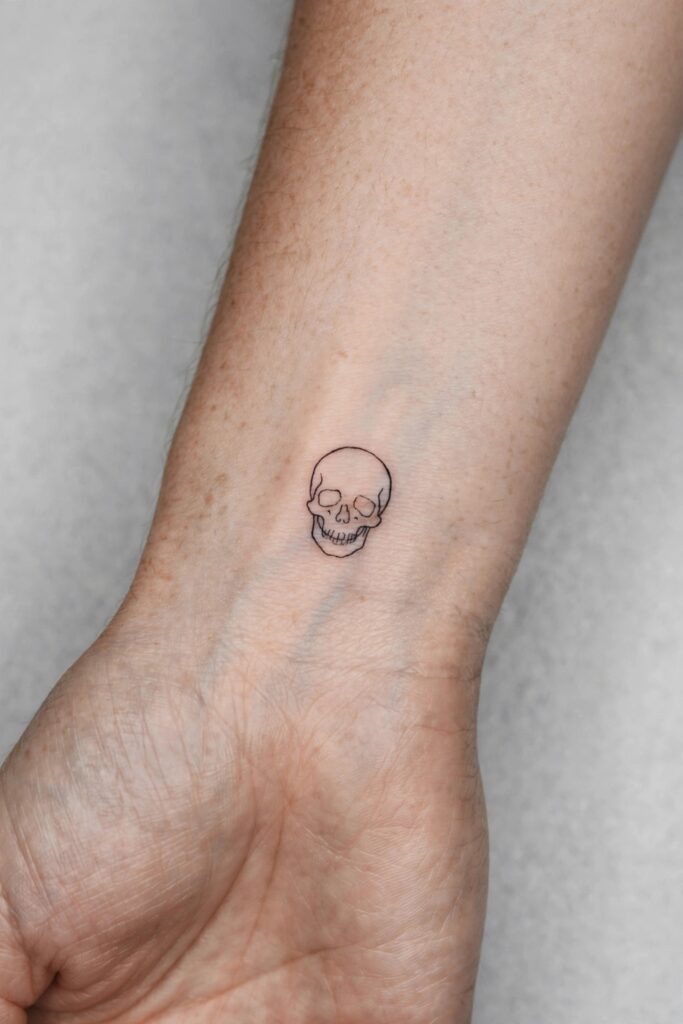
Meaning: A quiet reminder — small enough to miss at a glance, always there when the wearer looks down.
Design details: Minimal skull outline, fine lines, black ink only, no shading.
Size: 1–2 inches tall.
Best placement: Inner wrist, where it sits close and personal.
Recommended size: 1–1.5 inches tall; keep it simple or the lines blur.
Best for wearers who want the symbol without the statement.
22. Small skull behind the ear.
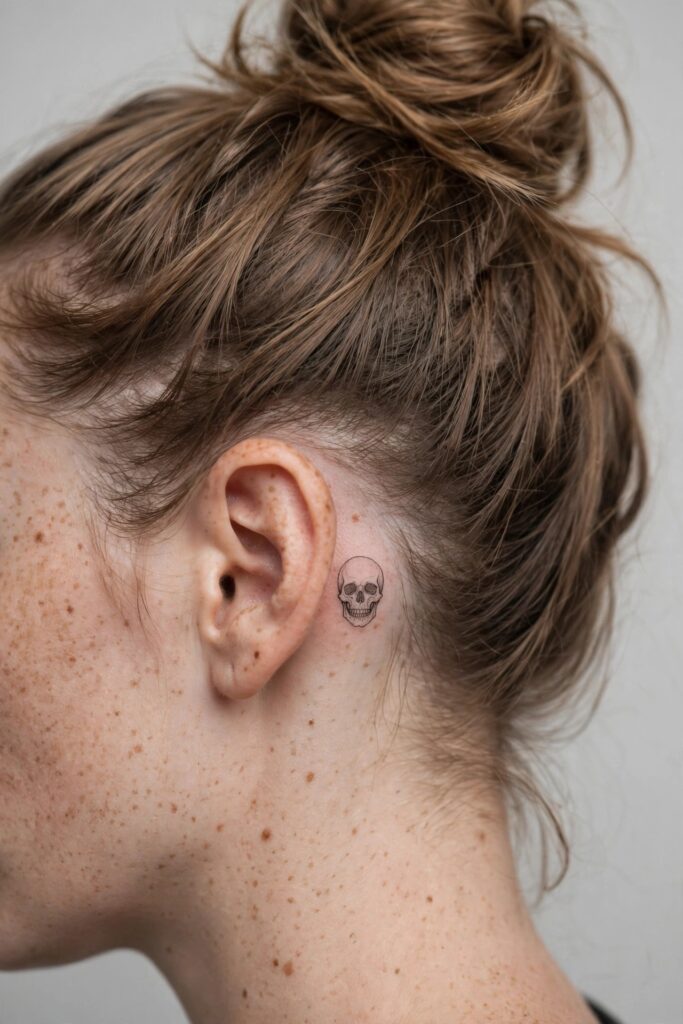
Meaning: A secret kept close — the skull behind the ear is for the wearer, not the room.
Design details: Tiny skull, fine line, black ink, fitted to the small curved space.
Size: Under 1.5 inches tall.
Best placement: Behind the ear, where hair can hide it or show it.
Recommended size: Under 1 inch tall, with no extra detail.
Best for wearers testing a skull for the first time.
23. Tiny skull on the finger.
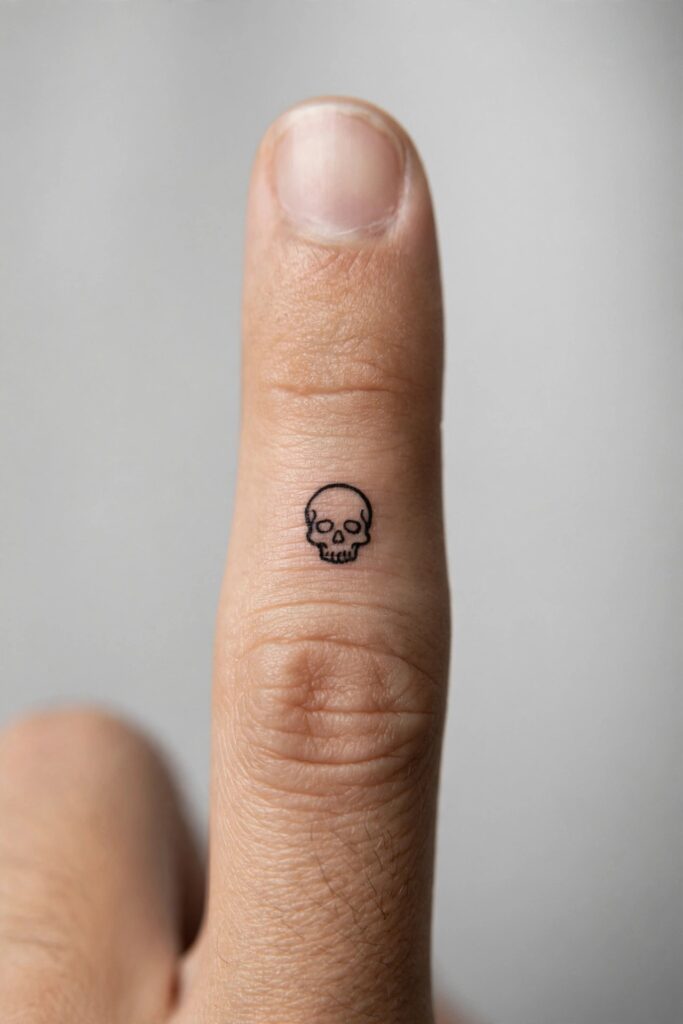
Meaning: Mortality on the hand that does the work — small, bold and impossible to ignore.
Design details: Tiny skull outline on one finger, bold lines, black ink.
Size: Under 1 inch tall.
Best placement: Side or top of a finger, fitted to the bone.
Recommended size: Fitted to one finger segment, bold lines only — fine lines on fingers blur within a few years, so this one needs to stay simple and expect touch-ups.
Best for wearers who want the smallest skull possible and know it will need care.
24. Skull with flames on the calf.
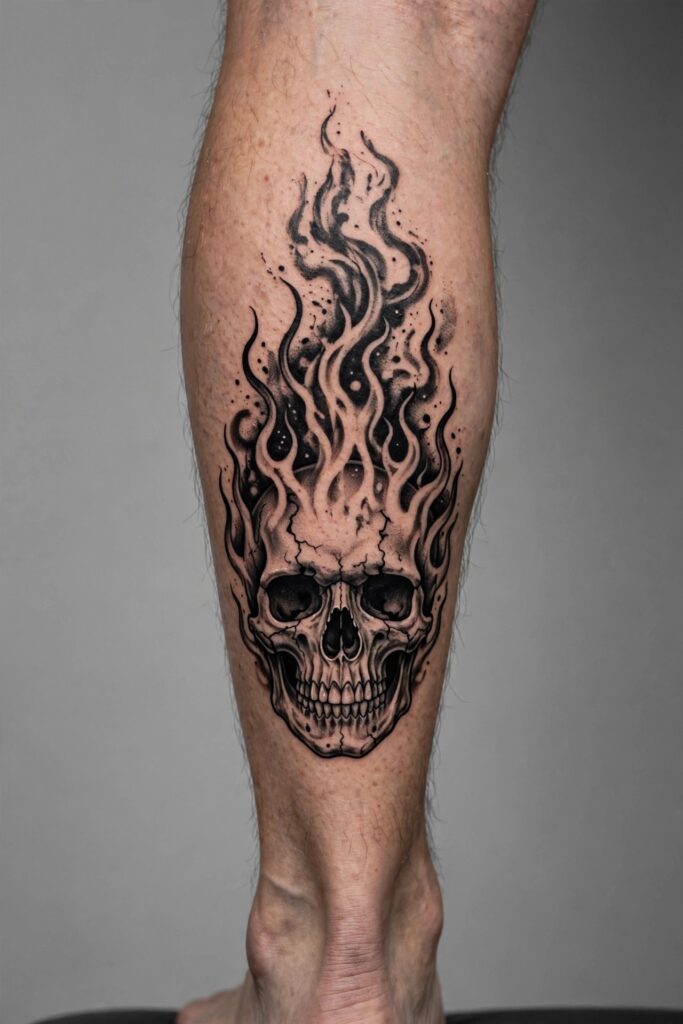
Meaning: Burning bright and burning out — the flaming skull is a life lived hard and fast.
Design details: Flames licking up from the skull, bold colour or black and grey, dynamic and tall.
Size: 4–7 inches tall.
Best placement: Calf, where the vertical flame shape follows the muscle.
Recommended size: 5–6 inches tall, so the flames keep their shape.
Best for wearers who live loud.
25. Skull and spider web on the elbow.
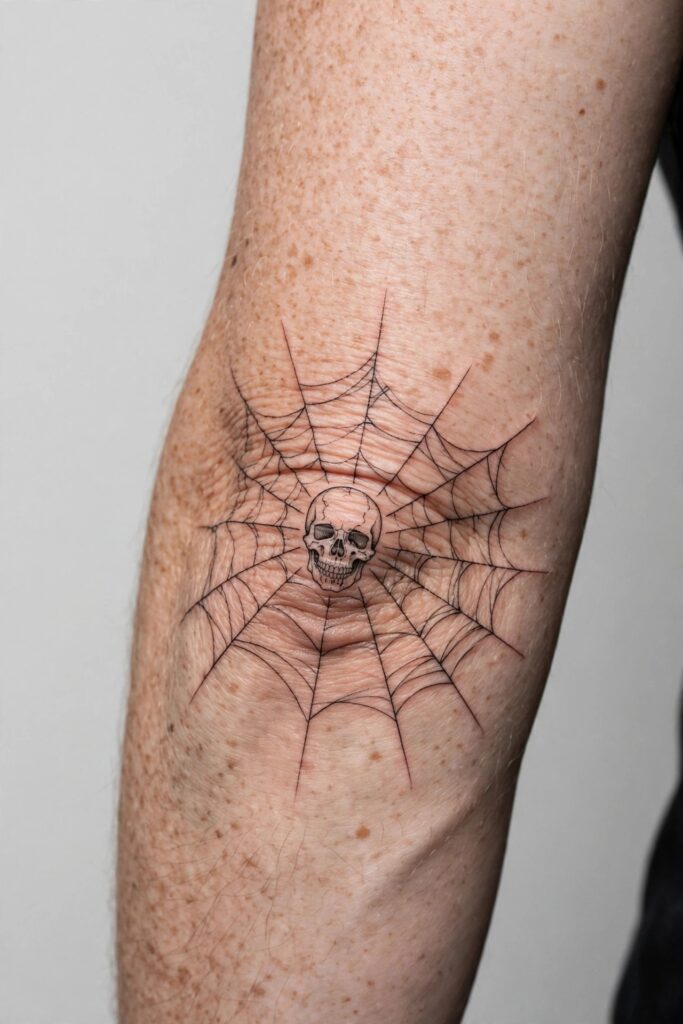
Meaning: Time served or time caught — the web is the classic mark of waiting, and the skull says what was waited through.
Design details: Web stretched across the elbow with a skull at its centre, thin lines, black ink.
Size: 3–5 inches across.
Best placement: Elbow, where the web’s shape follows the joint naturally.
Recommended size: 3–4 inches across, centred on the elbow point.
Best for wearers who know the history and wear it anyway.
Best Placements for Skull Tattoos
Skulls fit almost anywhere because the shape is simple — a rounded top and a flat jaw — but the size of the design should match the space. Large detailed skulls with pairings (raven, wings, peony, sword) need the back, chest or thigh, where the skin is flat and wide. Medium skulls suit the forearm and upper arm, the most popular spots, because the design stays visible and the skin there takes ink well. Small skulls belong on the wrist, behind the ear or on a finger, but keep the detail minimal — a small realistic skull loses its teeth and shading within a few years if it is packed too tight. Avoid the elbow and knee for fine detail; the skin moves and creases there, so bold lines survive better than thin ones.
How Much Do Skull Tattoos Hurt?
Skull tattoos hurt like any tattoo in the same spot — the design itself does not change the pain, the placement does. Forearm, thigh and upper arm are usually mild to moderate, around 4–6 out of 10. The chest, shoulder blade and calf sit in the middle, around 6–7. The spots that hurt most are the elbow, behind the ear, the fingers and the spine — thin skin over bone, around 7–9 out of 10. Sessions for a medium skull run one to three hours; a large back piece with a raven or wings can take two sessions.
How Much Does a Skull Tattoo Cost?
Small skulls usually cost $80–$200, medium pieces $200–$500, and large detailed work $500–$1,500 or more, depending on size, detail and colour. Prices vary by studio, city, artist experience and how many sessions the piece needs. A realistic skull costs more than a traditional one at the same size, because the shading takes longer. Choose by portfolio, not by the lowest price — a cheap skull with muddy shading is the one you will see every day.
Skull Tattoo Aftercare
Keep the tattoo clean and lightly moisturised, and do not pick at flaking skin. Skulls with heavy blackwork peel more visibly than fine line work, so moisturise often in the first two weeks. Keep the piece out of the sun while it heals, and wear sunscreen on it once healed — sun fades black ink faster than anything else. Avoid swimming and soaking for two weeks, and wear loose clothing over chest and back pieces so fabric does not rub the fresh ink. Bold skulls hold up well over time; fine-line skulls on the fingers and wrists will need touch-ups sooner.
More Tattoo Guides
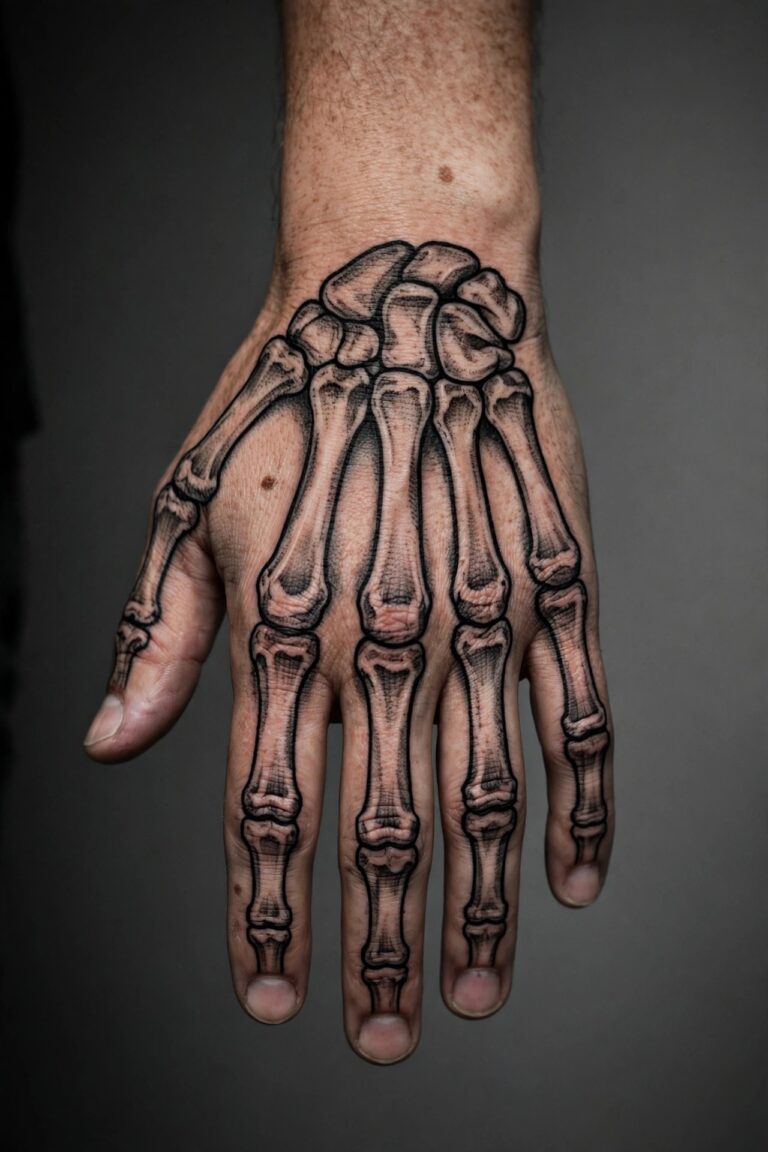
Skulls pair naturally with other dark and memorial designs. For faith-based pieces, see Cross Tattoo: 25 Designs and Meanings. For the philosophy behind the symbol, see Memento Mori Tattoo: 25 Designs and Meanings. For the darkest hand work, see Skeleton Hand Tattoo: 25 Dark Designs and Meanings.
Frequently Asked Questions
What does a skull tattoo mean?
Most often, mortality — a reminder that life is short, so live it fully. Sugar skulls add celebration and remembrance of the dead, while a skull with a crown or laurel adds power and honour. The exact meaning depends on the pairing, and many wearers give it a personal meaning of their own.
Are skull tattoos only for men?
No. Skulls are worn by everyone, and the design changes the feel more than the wearer does — a sugar skull or a skull with a peony reads very differently from a blackwork skull with a dagger. Placement and style matter more than gender.
Do skull tattoos hurt more than other tattoos?
No — pain depends on placement, not on the design. A skull on the forearm hurts the same as any forearm tattoo; a skull on the elbow or behind the ear hurts more because the skin is thin over bone.
How much does a skull tattoo cost?
Small ones usually run $80–$200, medium pieces $200–$500, and large detailed work $500–$1,500 or more. Realistic shading costs more than bold traditional work at the same size, and prices vary by studio and artist.
Will a small skull tattoo fade?
Yes, faster than a large bold one — especially on the fingers, wrist and behind the ear, where skin regenerates quickly and sun hits daily. Keep small skulls simple and bold, wear sunscreen, and expect touch-ups every few years.
Final Thoughts
A skull tattoo works because it is honest — it says what every other design only hints at. Pick the pairing that fits your story, give it the size its detail needs, and choose an artist whose healed skull work you have actually seen. Worn well, it is the boldest quiet statement in tattooing.